You can now buy the recently released book, Fall of a Thousand Suns: How Near Misses and Comet Impacts affected the Religious Beliefs of our Ancestors. It is available through iBooks and Amazon.
This website only lists information on modern-day comets and meteor showers. The book, however, thoroughly investigates how specific ancient impacts and near misses changed religious beliefs around the world.
Perseid Meteor Shower
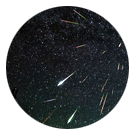
Discovery of the Perseid Meteor Shower
The Perseids have been observed for at least 2,000 years.
The first recorded observation comes in 36 CE, when a Chinese astronomer claimed that "more than 100 meteors flew thither in the morning." Observations in the 8th, 9th and 10th centuries from Chinese, Korean and Japanese astronomers were commonplace, but only a few mentions can be found between the 12th and the 19th centuries.
However, credit in the Western world for the discovery of the Perseid Meteor Shower belongs to Adolphe Quételet who, in August of 1835, observed meteors radiating from the constellation Perseus.
- Discovery of Perseid Meteor Shower
- The parent body of the Perseid Meteor Shower
- When are the Perseids visible?
The Parent Body of the Perseid Meteor Shower
Italian astronomer G.V. Schiaparelli was the first to suggest that Comet Swift-Tuttle (109P/Swift-Tutttle) was the parent object of the Perseid Meteor Shower. He did so in 1866, four short years after the discovery of Comet Swift-Tuttle. It was the first time that a specific meteor shower had ever been linked to a specific comet.
The comet has a periodic orbit of 133 years. If it passes close to Earth orbit during its perihelion, then the Perseid Meteor Showers in subsequent years can be particularly intense. After Comet Swift-Tuttle's most recent appearance in December of 1992, the Perseids were incredible when viewed from central Europe in August of 1993. Observers counted between 200 and 500 meteors an hour.
When are the Perseids visible?
The Perseid Meteor Shower is visible in August every year. It peaks around August 12. Although other meteor showers occur around the same time as the Perseids, the Perseids radiate from the constellation Perseus and its meteors travel across the sky faster than those associated with any other meteor shower.
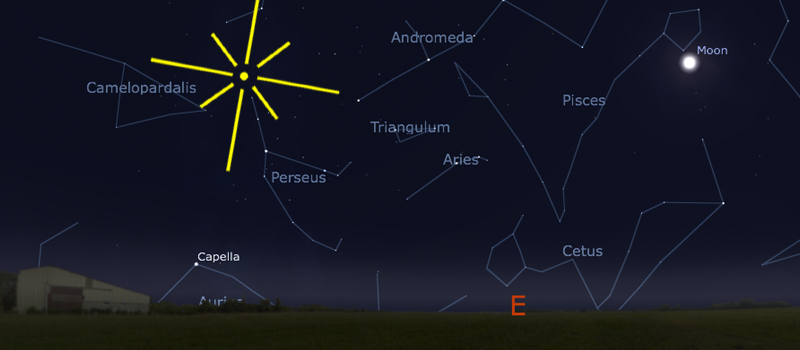
Radiant of the Perseid Meteor Shower
Credit: Stellarium with radiant by Kevin Curran