You can now buy the recently released book, Fall of a Thousand Suns: How Near Misses and Comet Impacts affected the Religious Beliefs of our Ancestors. It is available through iBooks and Amazon.
This website only lists information on modern-day comets and meteor showers. The book, however, thoroughly investigates how specific ancient impacts and near misses changed religious beliefs around the world.
Kappa Cygnid
Meteor Shower
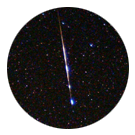
The first recorded observation of this meteor shower was on August 11 and 12 of 1874. Hungarian astronomer N. de Konkoly while observing the much stronger Perseid Meteor Shower, recorded seven meteors that radiated from the star Kappa Cygni in the constellation Cygnus.
Contents
- Discovery of Kappa Cygnid Meteor Shower
- The parent body of the Kappa Cygnid Meteor Shower
- When are the Kappa Cygnids visible?
The parent body of the Kappa Cygnid Meteor Shower is unknown.
The Kappa Cygnid Meteor Shower can be seen from July 26 to September 1, at the same time as the scene-stealing Perseid Meteor Shower. The Kappa Cygnids peak on August 18, one week later than the Perseids. It is a minor, relatively weak meteor shower, which at its peak it produces roughly six meteors an hour. The meteors are usually bluish-white, and have produced fireballs on occasion around the peak.
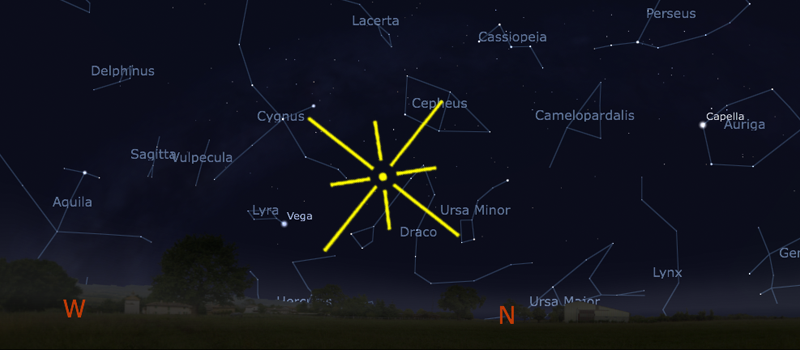
Radiant of the Kappa Cygnid Meteor Shower
Credit: Stellarium with radiant by Kevin Curran